 palmER
Charting dominates the shift
You spend more time clicking boxes than at bedsides. Charts follow you home. Family time disappears between hospital and laptop.
palmER is the premier AI-powered charting platform built for emergency medicine and urgent care. Your notes, written automatically by Ambient Scribe. Your MDM, done in seconds. Better notes. Faster charting.








From Mayo Clinic, Johns Hopkins, Stanford, Yale, UCSF, UCLA Health, Duke Health, Penn Medicine, and Harvard-affiliated hospitals to 150+ other health systems, academic medical centers, community EDs, and emergency medicine groups.
palmER pairs ambient HPI and Exam scribing with the MDM Assistant that captures differential diagnosis, risk stratification, and disposition reasoning—built for the way an emergency shift actually runs.
You spend more time clicking boxes than at bedsides. Charts follow you home. Family time disappears between hospital and laptop.
“Did I document everything? Will this hold up if it ever gets reviewed?” The chart you wrote at hour ten is the chart your defense rests on.
Cookie-cutter dot phrases bury the complexity of your actual reasoning. Notes that should justify a high-acuity workup read like primary care visits.
You managed three critical patients at once, but the note reads like a routine visit. Undercoded charts quietly cost you RVUs every shift.
palmER listens during your encounter and writes the HPI and Physical Exam automatically. Walk back to the workstation with the chart already drafted.
Start the session and palmER listens through the device microphone, showing a live waveform while you stay with the patient.
The Ambient Scribe drafts your HPI and Physical Exam notes automatically, with relevant positives and negatives.
Add findings that were not said aloud. Switch patients without losing context. Stop and restart as the shift demands.
palmER runs speech recognition on its own on-premises GPUs. Speech is transcribed and immediately discarded. No human-listenable audio ever exists on our servers, and patient data deletes automatically within 24 hours.
Why: Septic shock with persistent hypotension required IV fluids, norepinephrine, antibiotics, and ICU-level care.
Colab identifies critical care and procedures in the encounter. Click to draft a complete note, then edit it directly or ask Colab to make a change.
See how Colab worksAmbient capture, MDM generation, HPI and exam drafting, and the palmEM clinical reference, all in a single ED-native workspace.
Paste your chart and generate risk stratification, differential reasoning, orders, consults, and disposition.
palmER listens during your encounter and drafts the HPI and Physical Exam automatically. Speech is transcribed and discarded. No audio is ever stored.
Generate complete histories and focused exams with all the relevant positives and negatives.
The trusted palmEM AI knowledge base is built into palmER for fast, EM-specific answers.
In the ED, the MDM is the chart. Clinical reasoning, billing, and medico-legal defensibility intersect in one section, and it is the section that takes the longest to write well. palmER generates a complete, defensible MDM in seconds.
Every MDM highlights what matters most: the diagnoses that cannot be missed, the working differential, and the key clinical findings.
The can't-miss diagnoses for this presentation, there when you need them.
A working differential anchored to this case, not an exhaustive textbook list.
The findings that matter, pulled from the chart, and flagged in one place.
Complexity that stays in your head doesn't count. The MDM states the problems addressed, the data reviewed, and the risk you carried, in the structure billing and defensibility both require. What you sign is what you did. The chart stands on its own.
Switch from conversational chat to a unified Chart View whenever you want to review the whole note. Edit inline, ask for a refinement, and copy to your EMR when ready.
An emergency shift runs on a board, not an appointment book: multiple patients in parallel, constant interruptions, and unscheduled encounters. palmER's patient panel is built around that reality.
Use Assistant Mode for chart-paste workflows and direct prompts. Use Patient Mode when you want palmER to listen ambiently to encounters and let the HPI and Exam generate automatically. Switch any time.
HPI, Exam, and MDM documentation, ConsultER, Chart CheckER, and the palmEM AI clinical reference—built by emergency physicians for emergency clinicians. Everything works alongside any EMR, with no integration project.
Ask clinical questions with the patient’s chart already in context. Draft discharge instructions, school notes, and other patient documents. When Colab detects critical care or a procedure, write the note from its card.
From clinical questions to custom documents, Colab helps with whatever you need.
Explore palmER ColabCustomize palmER to match your documentation style with reusable snippets and custom instructions.
Keep common requests ready, from starting a note to refining one already generated. Choose a saved prompt instead of typing the same instruction again.
Tell each assistant how notes should be written, from structure and detail to what should appear every time. palmER applies those preferences automatically.
palmER saves about five minutes on every patient. Across a full shift that is two hours back. Across a year, it is twelve days of your life returned to you, your family, and the medicine you came here to practice.
The patients keep coming. The documentation no longer piles up behind them.
Type out the HPI and Exam between every patient.
Stare at a blank MDM at the end of each chart.
Stay an hour past sign-out finishing notes.
Wonder if the chart will hold up if it ever gets reviewed.
The HPI and Exam draft themselves while you see the patient.
Paste the chart and generate the MDM from the full clinical picture.
Chart CheckER gives the completed chart a final quality review.
Walk out with the board cleared and every chart defensible.
palmER is for emergency and urgent care clinicians managing multiple patients, making complex decisions, and turning clinical reasoning into clear, defensible documentation.
Clear, defensible documentation that reflects the complexity of emergency care.
Focused HPI, Exam, and MDM support from the encounter through the completed chart.
Structured documentation that makes the clinical reasoning behind each decision clear.
Fast, focused charts that reflect the care delivered without unnecessary detail.
More consistent documentation across the team with less friction during every shift.
A shared standard for clearer, more consistent charts across clinicians and shifts.
HPI and exam drafted while you listen.
Listen now. Reconstruct it later.
Paste your chart, get the MDM.
Another chart to write from scratch.
Each patient's work in one place.
Pick up the pieces after every interruption.
Critical care, procedure, and sepsis documentation drafted.
More care delivered. More notes to write.
A focused script, ready for the call.
Sort the chart while the phone rings.
Instructions, work notes, and school notes, drafted.
The patient is ready. The paperwork isn't.
palmEM inside the workspace.
Another tab. Another search.
The BAA is built in, with no extra paperwork required.
Data is encrypted in transit and at rest, with strict access controls and audit logging.
Audio is never stored. Patient data is automatically deleted within 24 hours.
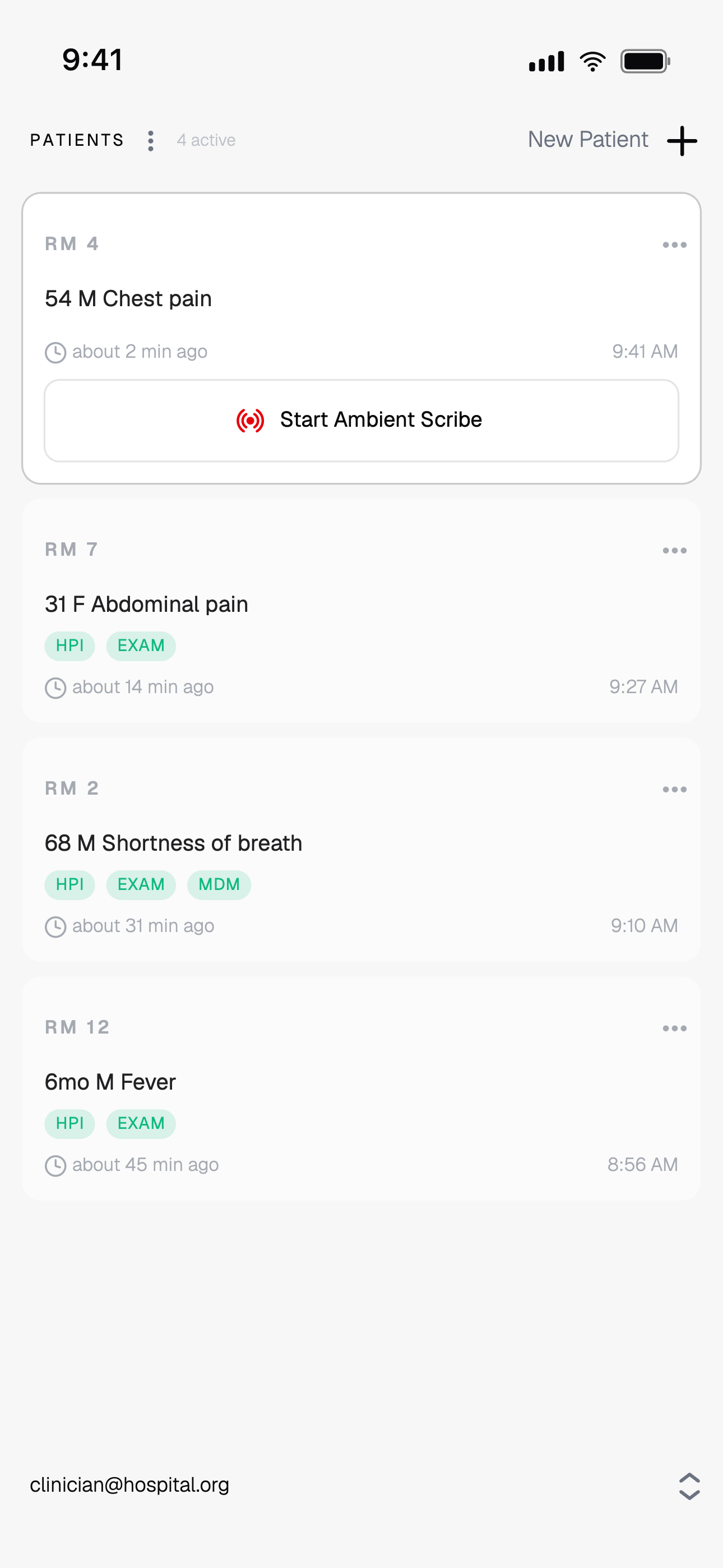
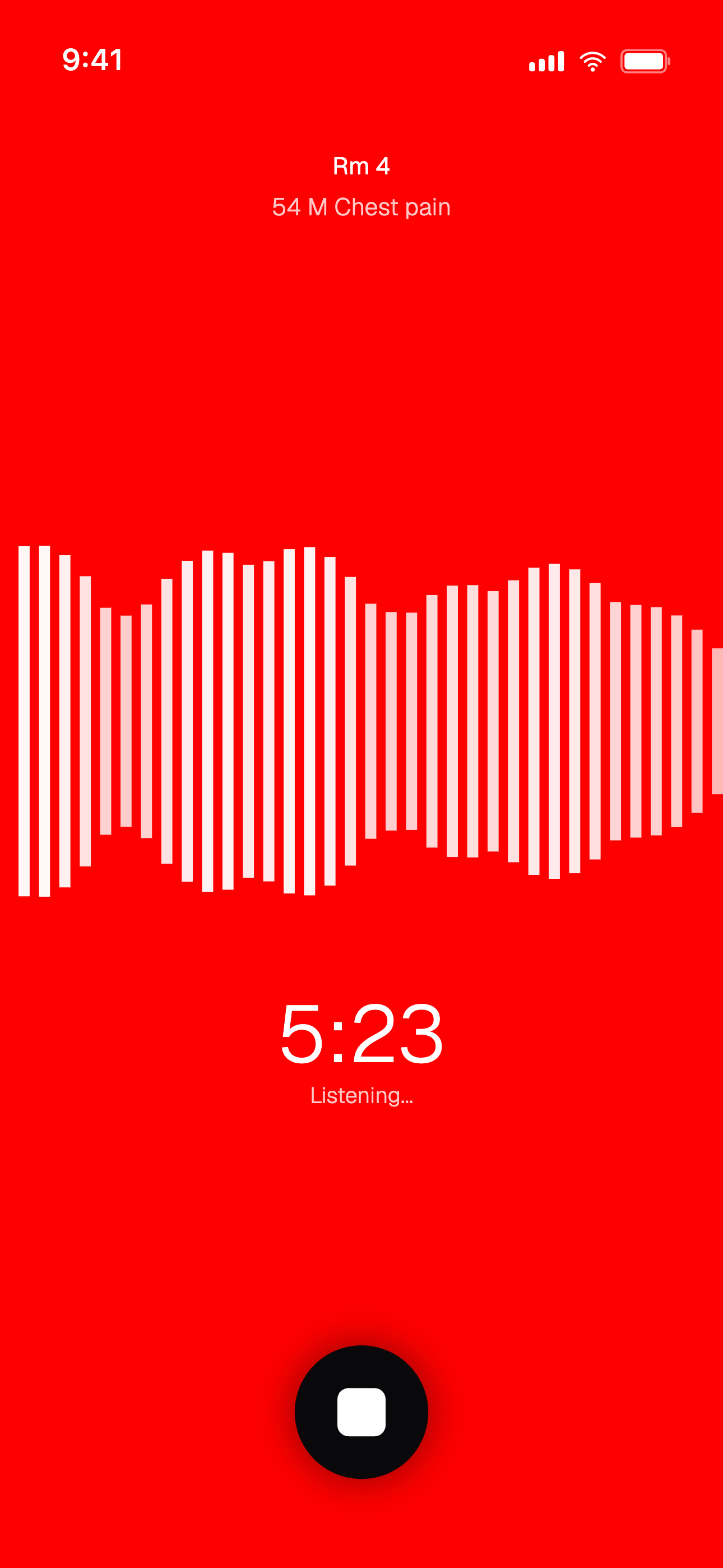
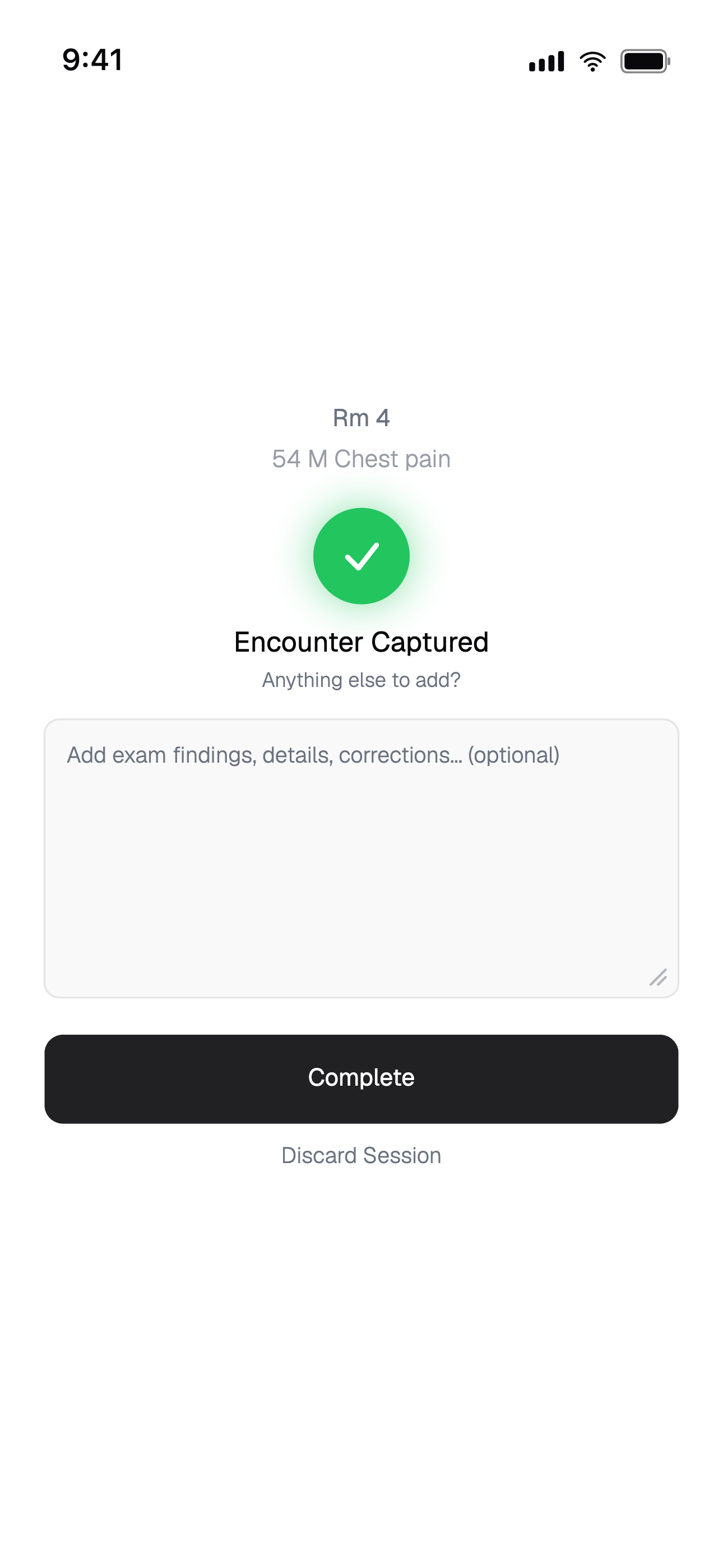
Documentation takes a quarter of every shift. palmER gives most of it back, and nothing is left waiting after sign-out.
3 gaps found · risk discussion, repeat ECG timing, shared decision-making
Not yet · complexity qualifies, but the data review needs more documentation
Drafted · plain English, return precautions included
Real clinicians. Real shifts. Their experience with palmER.
Everything clinicians ask before they trial it: privacy, your EMR, the price, and whether any of it holds up on a real shift.
Ambient scribing means the AI listens during your patient encounter and generates documentation from the conversation. Most ambient scribes were designed for office visits in a peaceful clinic: scheduled appointments, one patient at a time. That doesn’t work in the ED.
palmER’s Ambient Scribe was built specifically for emergency medicine. See your patient, and palmER writes your HPI and Physical Exam automatically. Switch between patients instantly. Stop and restart scribing as your shift demands without losing context. Add exam findings or corrections after scribing that weren’t said aloud.
No audio is ever stored on our servers or sent to any third party. Speech data is processed and then immediately discarded.
Privacy and security aren’t afterthoughts. They’re foundational. palmER is HIPAA-compliant by design. Your data is only used for one purpose: to respond to what you ask for. Nothing else.
We use enterprise-grade encryption (AES-256 at rest, TLS 1.2+ in transit), strict access controls, and comprehensive audit logging. We act as your Business Associate under HIPAA, and we maintain Business Associate Agreements with all subprocessors who may handle PHI. When you use AI features, data is routed only to providers with zero-retention agreements, meaning your data is processed to generate a response but never used for training.
For more details, review our Security & HIPAA page.
If it exists, assume it can be requested. When an AI scribe is purchased by your employer or hospital, or comes embedded in your EMR, it may retain the audio of the encounter, the verbatim transcript, the AI’s draft notes, and your typed inputs long after you sign, and retained data is discoverable in litigation. That shadow record can describe the encounter differently than your signed note does, and most clinicians have never seen the contract or hospital policy that decides how long it exists.
palmER keeps nothing to discover. Audio is never saved: it is transcribed and discarded, so no recording of the encounter ever exists. Transcripts, drafts, and chats auto-delete within 24 hours. Once you sign, the note in your EMR is the only lasting record, just as it was before AI.
Even if your hospital already provides a scribe, it is worth asking what it retains. We wrote up what the major tools keep and the questions to ask.
Hospital-provided AI, whether an ambient scribe or note writing built into the EMR, was bought for the system, not for you. It is typically tuned for scheduled clinic visits and generic notes, not for the multi-patient ED shift or the structured, defensible MDM that emergency medicine documentation hinges on. palmER is built for exactly that: a complete MDM with differential and risk stratification in seconds, plus ambient scribing designed for interrupted, multi-patient work.
There is also the question of what the hospital’s tool keeps. Its retention is set by contract and hospital policy, and retained audio, transcripts, drafts, and inputs are discoverable in litigation. palmER retains nothing: audio is never saved, patient data auto-deletes within 24 hours, and the only lasting record is the note you sign.
And palmER is portable. Your account belongs to you, not your employer, so it goes wherever you practice: the main ED, the community site, the locums shift, your next job. It works alongside any EMR with no integration step, so changing hospitals never means losing your workflow.
Templates give you the same generic text for every patient. Dictation transcribes what you say but doesn’t do anything with it. You still have to organize, structure, and review everything yourself.
palmER is different. With Ambient Scribing, it listens to your encounter and writes your HPI and Exam for you. With the MDM Assistant, you paste in your full chart and get a defensible MDM that captures your clinical reasoning, differential diagnosis, and risk stratification. The AI understands the clinical context of each case and generates documentation specific to your patient’s presentation.
The difference is that palmER does the thinking about documentation structure so you can focus on the clinical thinking.
Ambient scribing built for the ED, not adapted for it. Most ambient scribes were designed for clinic workflows. Scheduled appointments, peaceful office visits, one patient at a time. That falls apart in the emergency department. palmER was built from the ground up by practicing emergency physicians for the way the ED actually works.
palmER listens during your encounter and auto-generates your HPI and Physical Exam before you’re even back at the computer. Paste in your full chart and get a complete, defensible MDM that captures the full complexity of your clinical thinking. Switch between patients instantly. Stop and restart charting as your shift demands without losing context.
Less typing, fewer clicks, and documentation that reflects the care you’re actually providing. No audio is ever stored on our servers or sent to any third party. Speech is transcribed and immediately discarded.
As a palmEM subscriber, you have access to the palmEM AI knowledge base on the web within palmER AI Suite at no additional cost.
The full palmER AI Suite, including Ambient Scribing, MDM generation, and all documentation assistants, requires a separate subscription at $199/month. These are different products that serve different purposes: palmEM is a mobile clinical reference, palmER AI Suite is a documentation platform.
Sign up and get full access to every feature for 30 days.
After the trial, you can subscribe at $199/month to continue using all features.
palmER saves most users 2+ hours per shift. That’s 20+ hours a month. Over 10 days every year. palmER also helps you document the full level of care you’re actually providing.
Is an hour of your time worth $2? That’s what it comes down to. And the 30-day free trial costs you nothing to find out.
Group discounts, not at this time. Our costs scale directly with each additional user because every note generated requires significant real-time AI compute. The $199/month pricing reflects the true cost of delivering clinical-grade AI documentation. Many groups are adopting palmER and we’re listening to feedback as we grow; if group pricing becomes feasible, we’ll announce it.
We do offer a trainee discount for students and residents: see our trainee page for details. We also offer an active duty military discount: contact us from your .mil email address.
One thing worth noting: your palmER subscription follows you. It’s not tied to a facility or EMR. Change sites, pick up extra shifts, switch healthcare systems. palmER comes with you.
Start a trial tonight, paste your first chart, and watch the MDM build itself. Thirty days, no card, no auto-billing. If a note misses something, tell us. Clinicians read every report.