 palmER
ConsultER.
Turn a short clinical summary into a structured consult script in seconds, with the right framing and answers consultants need.
ConsultER turns a short clinical summary into a polished consult script in seconds. You get the opening, the talking points, and the pushback you'll likely face, so you're ready for anything.
What ConsultER Generates
Good consult calls follow a pattern. You introduce yourself, lead with the key clinical problem, explain why it matters now, and ask for what you need. ConsultER captures that rhythm. Enter a brief request in your own shorthand or paste the whole chart, and you get back a structured, professional script in your voice.
Because the script is built from your summary, the language stays yours. It states what you need, gives the consultant what they need to decide, and respects their time.
How to Use ConsultER
Enter a brief consultation request, or paste the entire chart:
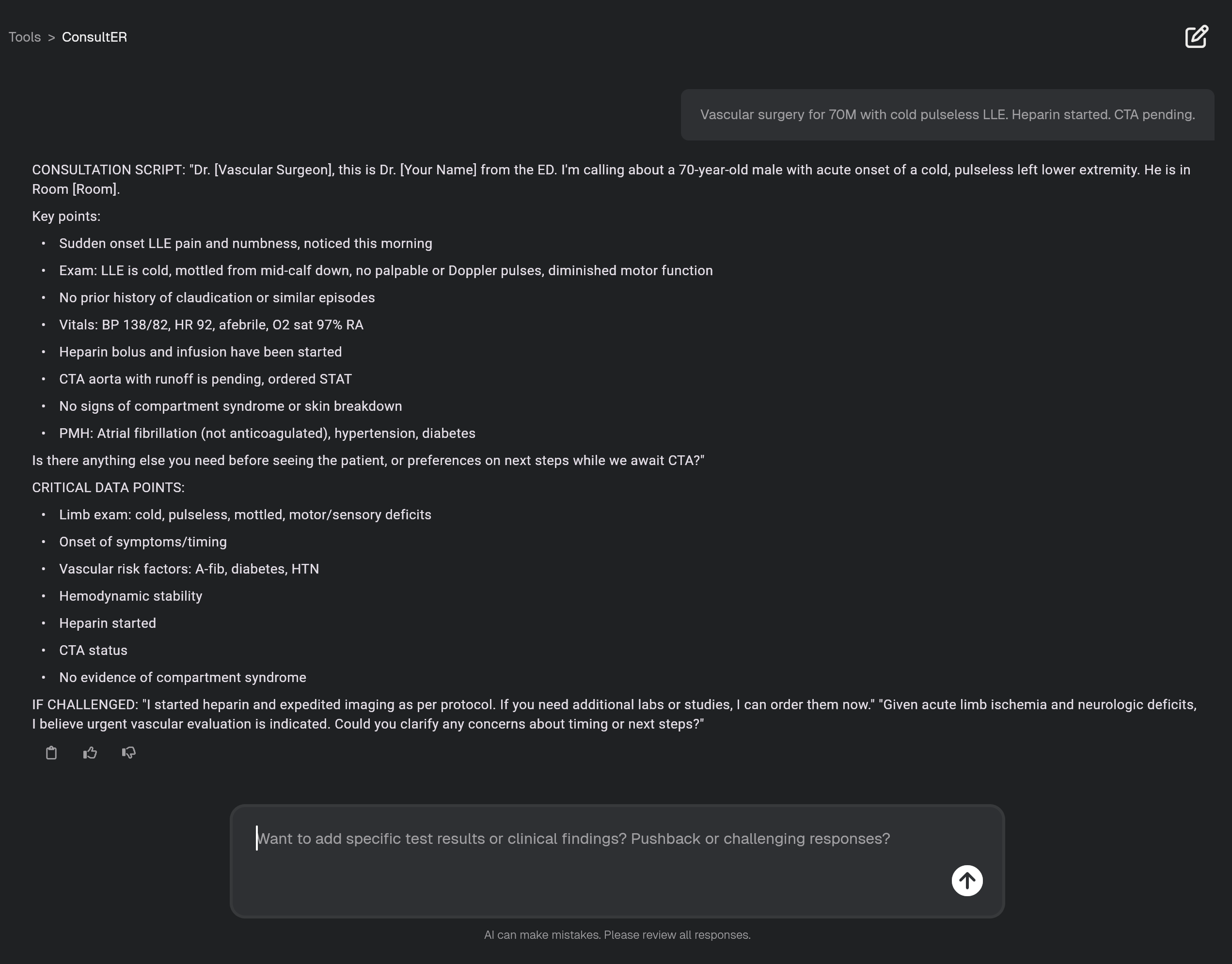
Consult vascular surgery for 70M with cold pulseless left leg. Heparin started. CTA pending.ConsultER returns three things you'll use on the call.
From the sidebar in the Patients workflow
When you launch ConsultER from the sidebar, it already knows everything about the patient. Just tell it who and what you need. You get a script tailored to this patient.
Adapting to the Situation
The script adapts to the urgency you describe. Type open tib-fib fracture, ortho needed now and you get an urgent opening. Type stable patient with slow GI bleed, GI input appreciated and the tone shifts accordingly. Same workflow either way; the context does the work.
What the Script Includes
The script includes everything you need for the call: key clinical points, anticipated questions, and responses to pushback, all in one place. Use follow-ups to refine the script or feed in new findings.
By Specialty
Example Inputs
Time-critical case
STEMI in 58M, cath lab activation needed.ConsultER frames the urgency clearly and recaps the data the cardiologist needs so the team mobilizes immediately.
Complex ICU case
67M in septic shock with AKI and respiratory failure. Need ICU.The script threads hemodynamics, labs, and current management together. You enter the conversation knowing how to articulate escalation and level of care.
Transfer and disposition
45F with complex spine injury. Local OR not equipped. Need transfer.The script explains why your facility can't manage it, what you've done to stabilize, and what transport and staffing considerations matter. Receiving centers are more likely to accept when they understand the full picture.
Tip
Generate the script early. You'll enter the call already prepared with your opening, your talking points, and answers to the questions specialists will ask.
Good consult calls compound. Specialists respond faster to clinicians they trust. Response times are short. Patients get better care.
It starts with a clear script.