 palmER
AI Reference.
palmEM AI gives you instant, evidence-based emergency medicine answers—your intelligent clinical assistant on mobile, anytime.
You're three patients deep with two more in the waiting room when a question hits you: What's the dose adjustment for apixaban in renal insufficiency? or What are the indications for HFNC in COPD exacerbation? You could interrupt a colleague, dig through UpToDate, or keep wondering. Or you could just ask palmEM AI.
The AI Reference feature in palmEM AI is your on-demand clinical consultant - an intelligent assistant trained specifically in emergency medicine that understands your questions in context and provides actionable, evidence-based answers instantly.
What is the AI Reference?
The AI Reference is a conversational clinical assistant built into the palmEM AI mobile app (available on iOS and Android). It understands emergency medicine terminology, clinical contexts, and the kinds of questions you face during shifts.
Unlike searching Google or UpToDate, the AI Reference gives you direct answers tailored to your specific question rather than forcing you to wade through lengthy articles to find what you need.
What You Can Ask
The AI Reference handles the full spectrum of emergency medicine questions:
Patient Results and Interpretation:
What does an elevated troponin with normal EKG mean?When is a D-dimer falsely elevated?How do I interpret a QTc of 501ms in a patient on citalopram?
Differential Diagnoses:
Differential diagnosis for right upper quadrant pain in pregnancyCauses of elevated lactate in a non-septic patientWhat mimics appendicitis in young women?
Treatment Protocols and Medications:
Management algorithm for unstable SVTRocuronium dosing for RSI in an obese patientAntibiotic choices for complicated UTI with penicillin allergy
Procedures:
Landmarks for knee arthrocentesisHow to reduce a posterior shoulder dislocationTechnique for ultrasound-guided nerve block
Clinical Guidelines:
Current PE risk stratification toolsSepsis management bundle requirementsHypertensive emergency treatment guidelines
Pediatric Questions:
Weight-based epinephrine dosing for anaphylaxisCroup management in a 2-year-oldNormal vital signs for a 6-month-old
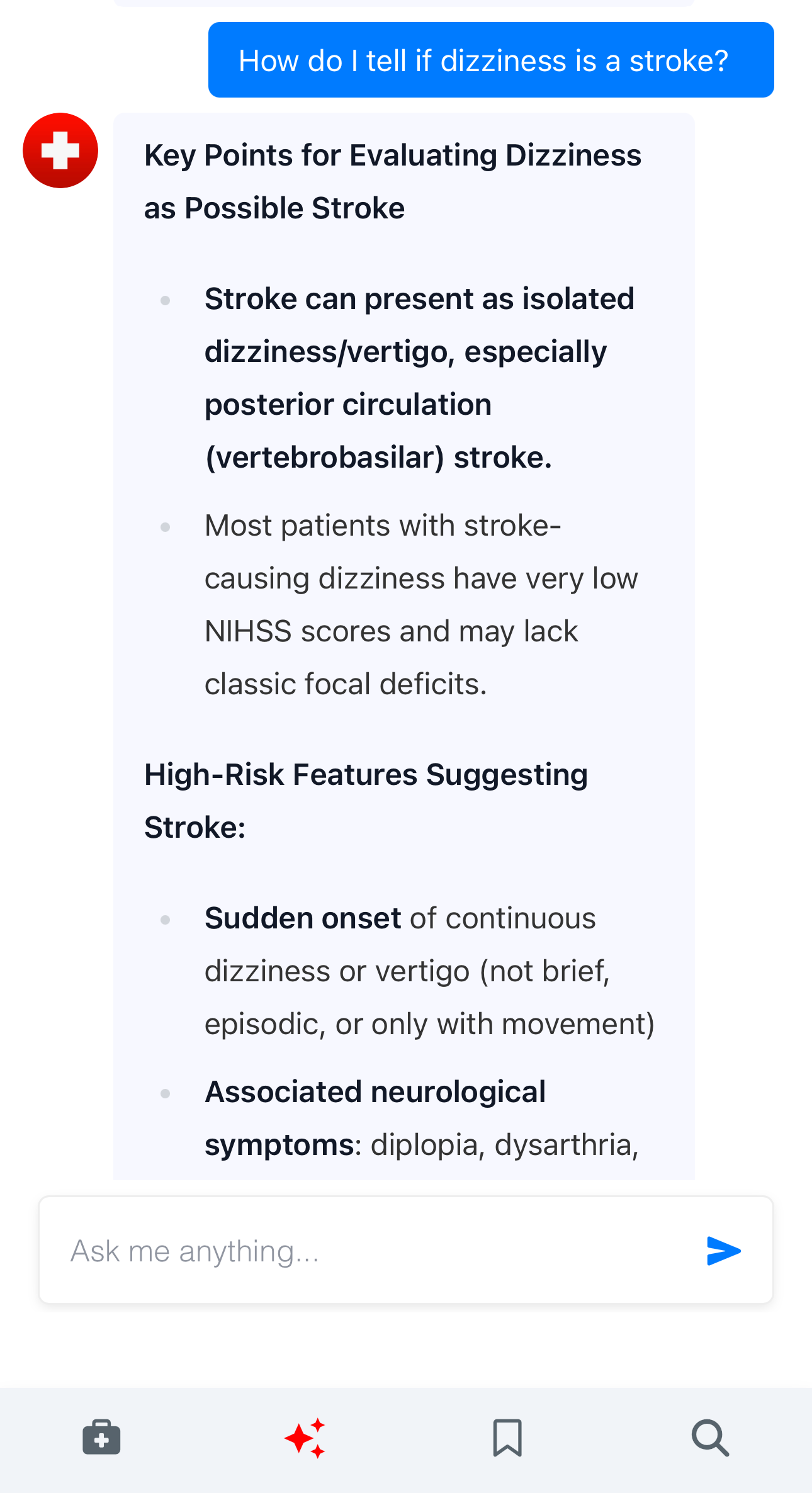
How to Use the AI Reference
- 01Open the AI Reference tab
Tap the AI icon in the bottom navigation bar of palmEM AI.
- 02Type your question
Enter your clinical question in the text field at the bottom of the screen. Ask in plain language.
- 03Tap send
Submit your question and receive an evidence-based answer in seconds.
- 04Ask follow-ups (optional)
The AI maintains conversation context - ask follow-up questions to dig deeper or clarify without repeating information.
Getting Better Answers
The more specific your question, the better the answer:
Less helpful: Tell me about chest pain
More helpful: Differential diagnosis for pleuritic chest pain in a young healthy patient
Less helpful: What's the sepsis protocol?
More helpful: Lactate is 4.2, BP 85/50 - walk me through sepsis management
Less helpful: Pediatric fever
More helpful: 3-month-old with fever to 38.5C - what's my workup?
Include relevant clinical context when it changes the answer (age, pregnancy, comorbidities, etc.).
Real-World Use Cases
During patient evaluation:
You're seeing a patient with suspected PE but the patient has a contrast allergy. You ask: V/Q scan interpretation for PE diagnosis and get a clear explanation of probability categories and when to anticoagulate.
At the medication cart:
You're about to push versed for a procedure and realize you're not sure about the dose in a morbidly obese patient. You ask: Midazolam dosing for procedural sedation in 350 lb patient and confirm your dosing strategy.
During teaching rounds:
A student asks about the difference between NSTEMI and unstable angina. You pull up palmEM AI and ask: Explain the difference between NSTEMI and unstable angina to show them a clear, concise explanation.
After an unusual case:
You just saw a case of Takotsubo cardiomyopathy. You ask: What are the EKG findings in Takotsubo cardiomyopathy? to refresh your knowledge and document better.
What the AI Reference Is Not
It's not a replacement for clinical judgment. You still need to synthesize information and make decisions based on your patient's specific situation.
It's not a pharmacist. The AI provides evidence-based guidance, but you're responsible for verifying doses and checking for contraindications specific to your patient.
AI Reference vs. Other Resources
Faster than textbooks and web references - Get direct answers without reading entire articles
More specific than Google - Responses are tailored to emergency medicine practice
More accessible than calling a colleague - Available 24/7 without interrupting anyone's workflow
More current than textbooks - Knowledge base is regularly updated with the latest evidence
Think of the AI Reference as your most knowledgeable colleague who's always available, never busy, and never annoyed by your questions - no matter how basic or complex.